

The global life sciences and medical device supply chain is currently facing a silent but relentless challenge. Volatility in global energy markets, shifting petrochemical capacities, and fluctuating logistics costs have combined to create an unpredictable environment for raw materials. For manufacturers relying on premium, medical-grade plastics—specifically high-purity polypropylene (PP)—the pressure is immediate and intense.
Every laboratory consumable, from a standard microcentrifuge tube to a specialized automation pipette tip, begins as a raw polymer granule. When the cost of these medical-grade resins climbs, factories worldwide face a critical junction. The easiest response is to simply pass the increased cost down the line to distributors, IVD (In Vitro Diagnostic) developers, and research institutions.
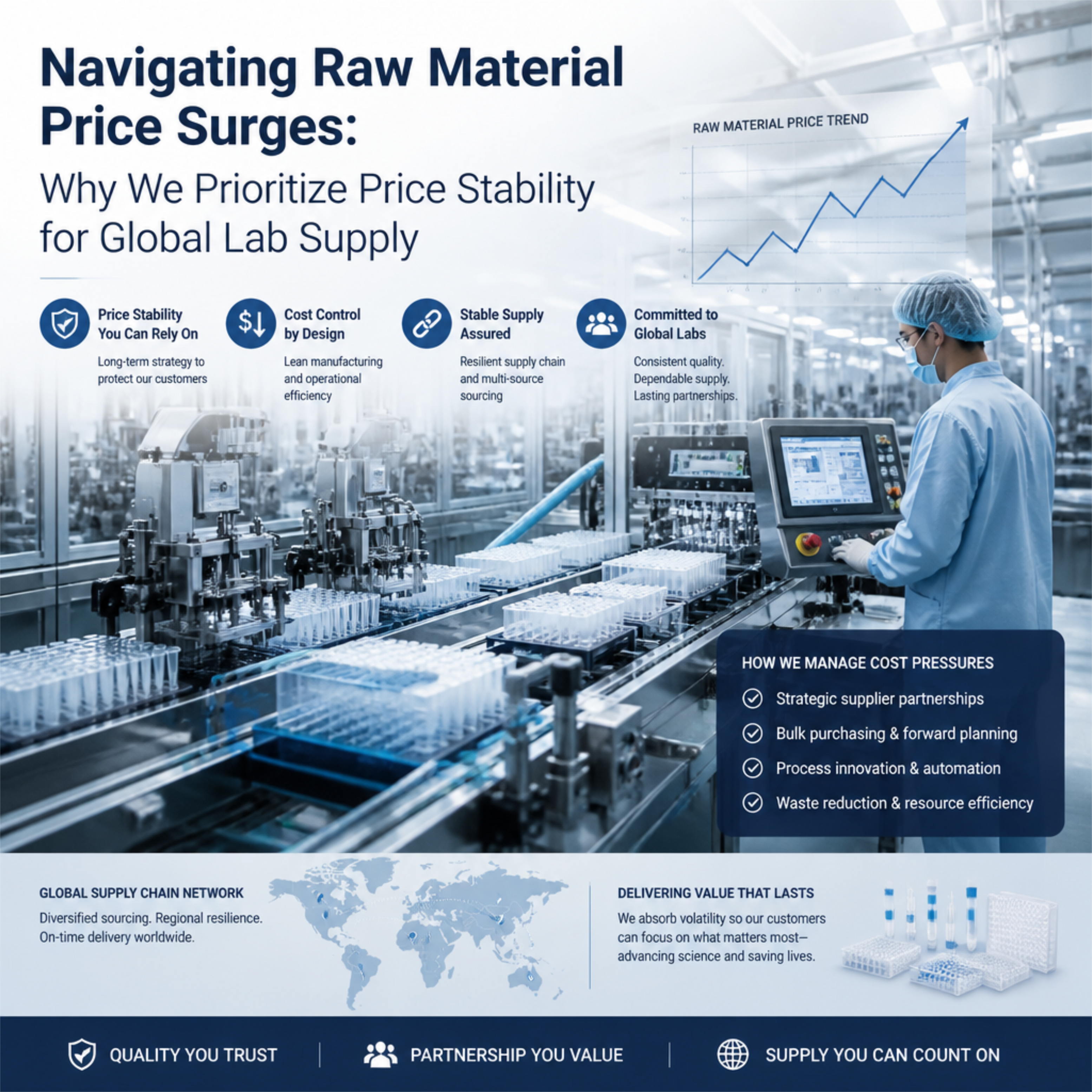
However, at Suzhou Ace Biomedical Technology Co., Ltd., we believe that the easiest path is rarely the right one. Instead of resorting to immediate price hikes, we have chosen to absorb these market shocks internally. It is a decision born out of a deep sense of responsibility toward our global partners, achieved through rigorous engineering adjustments, automation upgrades, and a commitment to long-term collaboration.
The Invisible Pressure on Low-Margin, High-Precision Manufacturing
To understand why a factory would choose to maintain steady pricing during a material cost surge, one must look at the nature of life science consumables. Products like PCR plates, 8-strip tubes, deep well plates, and reagent reservoirs are high-volume, low-margin utilities. They are the background infrastructure of modern science. A shift of even a fraction of a cent per unit can severely alter the economics of a massive procurement contract.
For an IVD manufacturer running high-throughput screening or a hospital system relying on thousands of disposable ear thermometer covers, oral thermometer covers, and otoscope specula daily, cost predictability is vital. Most of these organizations operate on strict annual budgets. Sudden price changes disrupt their operational stability, stall research projects, and strain procurement relationships.
We recognize that our clients do not just buy plastic from us; they buy predictability. If a supplier changes its pricing structure with every shift in the oil market, it ceases to be a reliable partner and becomes a variable risk. That is why our leadership team at Suzhou Ace Biomedical established a clear mandate: we protect our clients’ margins first, even if it means compressing our own in the short term.
Turning Inward: How We Fight Rising Costs on the Factory Floor
Absorbing material cost increases cannot be accomplished through wishful thinking; it requires deep operational optimization. If we cannot control the cost of incoming raw materials, we must gain absolute control over what happens to those materials once they enter our production facility.
1. Maximizing Mold Efficiency and Yield Rates
In injection molding, profit is won or lost in the details of the mold design. For intricate products like ultra-low retention pipette tips or thin-walled PCR tubes, precision is tied directly to material efficiency. Our engineering team has focused heavily on optimizing hot runner systems and cooling cycle times within our tooling.
By refining the thermal balance inside our multi-cavity molds, we have drastically reduced the cycle time required for each shot. Saving even two seconds per cycle scales up to massive energy and labor savings across a 24-hour production shift. Furthermore, this precision engineering minimizes scrap material and “flash”—the excess plastic that clings to the edges of molded parts. In our facility, every gram of medical-grade PP is utilized to its absolute maximum potential, driving our internal defect rates down to near-zero.
2. Doubling Down on Factory Automation
Manual handling is not only a source of potential biological contamination; it is an economic variable. To counter rising operational costs, Suzhou Ace Biomedical has consistently reinvested in automated manufacturing systems.
Today, our deep well plates and reagent bottles are extracted from molds via synchronized robotic arms, passed through automated inline vision inspection stations, and transferred directly to sealing and packaging lines within our controlled cleanrooms. This high level of automation drastically reduces human error, eliminates the cost of manual qc rejections, and ensures that our labor costs per unit remain flat, helping to offset the expensive raw polymers.
3. Strategic Sourcing and Polymer Partnerships
As an established player in the biomedical consumables sector, our purchasing volume gives us a distinct advantage. We do not buy materials on the spot market where prices fluctuate daily. Instead, we maintain long-term, direct-supply agreements with top-tier international chemical manufacturers. By committing to large, predictable volume forecasts, we secure preferential pricing and material allocations, shielding our production lines from sudden localized shortages and price spikes.
Optimizing the “Total Cost of Ownership” for Our Clients
Price stability at the factory gate is only one part of the equation. We also look for creative ways to save our customers money throughout the logistics and delivery process. If material costs are up, can we find savings in transport?
Our packaging design team actively re-engineered our bulk shipping configurations for high-volume orders. By subtly optimizing the nesting density of our deep well plates and the stacking arrangement of our centrifuge tubes, we managed to increase the product count per cubic meter inside shipping cartons.
This means that for our international clients managing CIF or CNF ocean freight, they are now moving more functional product per container than before. We are effectively lowering their per-unit shipping costs, which balances out the broader macroeconomic pressures of global trade.
The Philosophy of Shared Resilience
Every business cycle features periods of inflation and correction. We know that raw material surges do not last forever. However, the reputational damage caused by opportunistic price increases can last a lifetime.
At Suzhou Ace Biomedical Technology Co., Ltd., our business model is built entirely on the concept of shared resilience. We view our relationships with global distributors, laboratory networks, and medical device brands as long-term alliances. When our partners thrive and remain competitive in their respective markets, our factory floors stay busy.
The current economic climate is undoubtedly challenging, and operating with compressed margins requires immense discipline. Yet, walking through our facility today, watching the automated lines flawlessly turn out pristine sealing films, PP reagent bottles, and PCR consumables, there is a collective pride among our team. We are proving that through engineering excellence and operational grit, a manufacturing plant can stand as a buffer for its clients, providing stability in an unstable world.
Post time: May-25-2026