

In the world of life sciences, precision liquid handling is the cornerstone of reliable research and diagnostics. The journey from manual pipetting to fully automated systems represents a remarkable technological evolution that has transformed laboratory workflows. As a leading manufacturer of laboratory consumables, Suzhou Ace Biomedical Technology Co., Ltd. takes pride in being part of this transformative history.
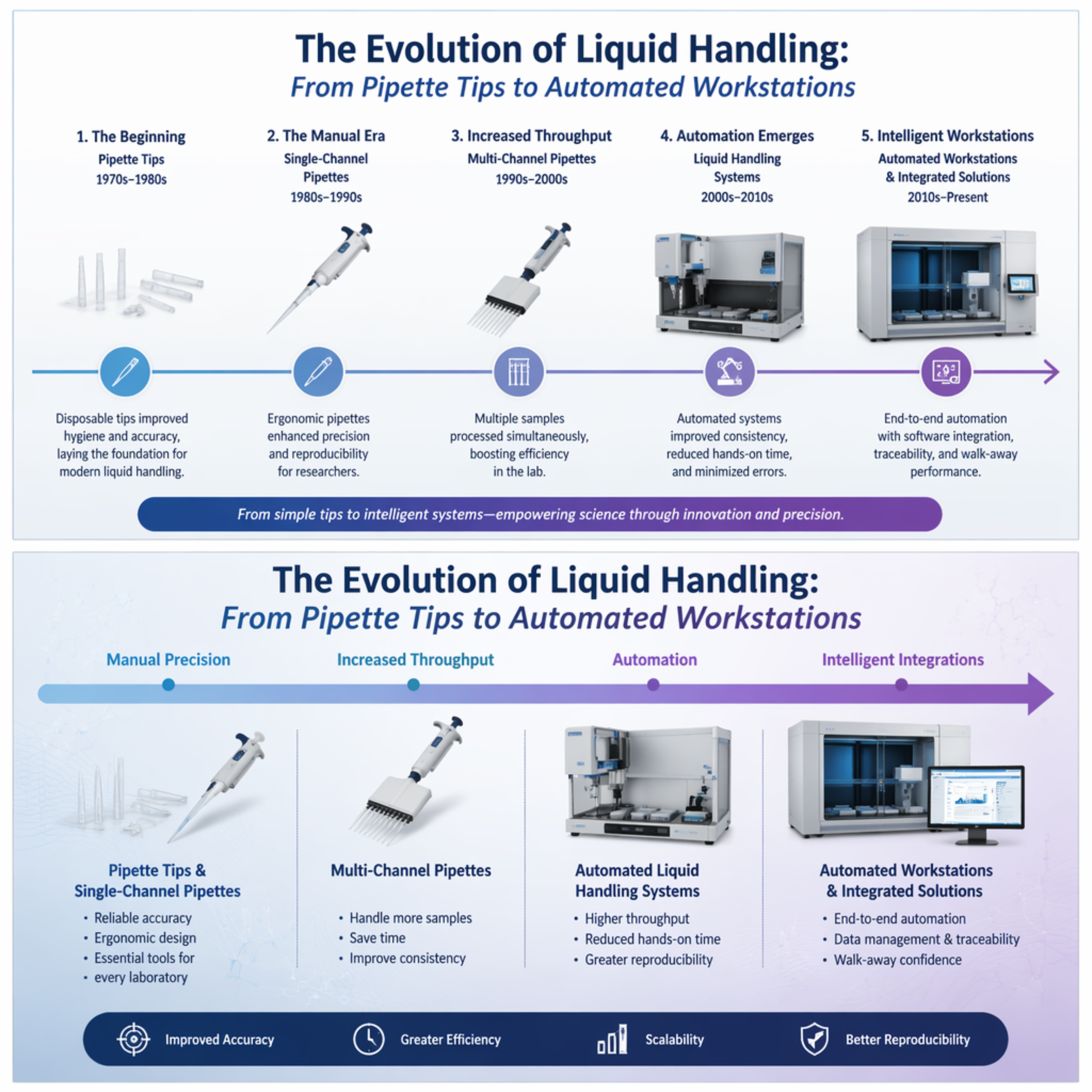
The Humble Beginnings: Pipette Tips
The story begins with the most fundamental component—the pipette tip. Before the 1950s, scientists relied on glass capillary tubes and even mouth pipetting, a hazardous practice that led to numerous laboratory-acquired infections. The breakthrough came in 1957 when German scientist Heinrich Schnitger invented the first air-displacement micropipette. By 1961, Eppendorf had commercialized this invention, marking the birth of modern pipetting.
The real revolution occurred in the 1980s with two critical developments: Eppendorf added filter barriers to tips in 1986 to prevent aerosol contamination, and Hamilton introduced disposable tips for automated systems in 1987, specifically for HIV and hepatitis testing. The 2005-2015 period saw the rise of qPCR and early NGS technologies, driving demand for tips free of enzymes and sample adsorption.
The COVID-19 pandemic (2020-2022) created unprecedented demand, with daily global consumption reaching millions of tips. This crisis accelerated technological advancements, leading to molecular-level surface treatments like Eppendorf’s “pearl effect” technology achieving 99.8% recovery rates for 0.2μL volumes. Today, we’re witnessing the integration of experimental steps directly into tips and the emergence of smart tips with RFID technology for tracking and data management.
The Precision Instrument: Pipettes
Heinrich Schnitger’s 1957 invention wasn’t just about the tip—it created the entire pipetting system. His modified tuberculin syringe with a spring-loaded piston became the prototype for all modern pipettes. Eppendorf’s acquisition of the patent and subsequent refinement with polypropylene tips created the iconic EP tube and pipette combination that revolutionized laboratories worldwide.
The 1970s brought significant advancements: multi-channel pipettes emerged in 1973 for handling 96-well plates, and in 1974, French company Gilson introduced the first adjustable single-channel pipette, named Pipetman. By the late 1970s, Gilson had separated the aspiration/dispensing buttons from the tip ejection button, creating the functional design still used today.
Electrification followed in the 1980s and 1990s, with RAININ introducing the first electronic pipette in 1984 and Finnish company Biohit launching its electronic models in the 1990s.
Automation Revolution: Liquid Handling Workstations
The quest for higher throughput and reduced human error led to the development of automated systems. The foundation was laid in 1947 when Clark Hamilton developed the microliter syringe. The true automation era began in 1980 with Hamilton’s Microlab 2000, the first fully automated sample preparation workstation.
Key milestones followed: Tecan’s Samplers 500 series in 1985 offered the first process-controlled automated pipetting workstation; Beckman Coulter’s Biomek 1000 in 1986 introduced tip-based liquid handling; and TomTec’s Quadra96 in 1990 became the first 96-channel liquid handling workstation.
The new millennium brought sophisticated technologies like Hamilton’s Microlab STAR in 2000, featuring air displacement, CO-RE technology, and liquid dual-sensing (ΔC-ΔP). Today’s systems offer unprecedented precision, with channel counts expanding to 384 and beyond, integrated with advanced software and robotics.
Current Trends and Future Directions
The liquid handling industry is experiencing several transformative trends. Automation compatibility has become essential, with approximately 65% of laboratories now using automated pipetting systems. Integration is advancing rapidly, with companies like DPX Technologies developing tips that incorporate nucleic acid purification media, eliminating the need for separate magnetic beads or spin columns.
Smart technology is emerging through RFID-enabled tips that track usage, volume, and sterilization cycles, though currently limited to high-end automated systems. Environmental sustainability is gaining traction with biodegradable polylactic acid materials becoming more accessible. Standardization has tightened significantly, with ISO 23753-2:2024 requiring molecular diagnostic tip microchannel diameter tolerances within ±2μm, compared to the previous ±10μm standard.
Precision in Every Drop
At Suzhou Ace Biomedical Technology, we understand that every scientific breakthrough begins with precise liquid handling. From our extensive range of pipette tips to deep well plates, PCR plates, and sealing films, we’re committed to supporting the evolving needs of modern laboratories. As the industry moves toward greater automation, integration, and intelligence, we continue to innovate, ensuring that researchers worldwide have access to the reliable consumables that form the foundation of scientific discovery.
The journey from manual pipetting to smart, automated systems demonstrates how seemingly simple tools can drive scientific progress. As we look to the future, we remain dedicated to providing the precision instruments that enable tomorrow’s breakthroughs today.
Post time: May-09-2026